Are the kids alright?
Children learn what they live, and as a result, Roblox users are re-enacting ICE raids and anti-ICE protests on platform.

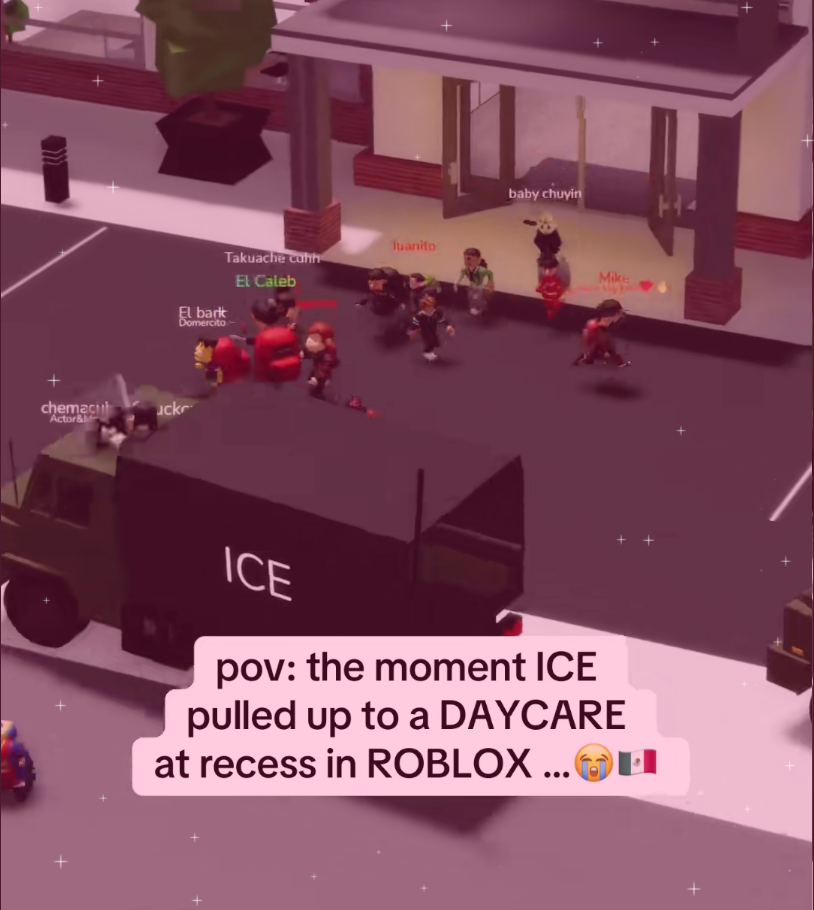
A car drives onto a daycare’s curb, hitting protesters in the process. Armed ICE agents follow, shooting at other players pouring out of the virtual daycare’s doors. One player lies in a puddle of computer-generated blood after being shot by a user playing as an ICE agent.
This is not Minneapolis, Minnesota, but user-created experiences on Roblox.
In recent weeks, Roblox users have re-enacted ICE operations at daycares, hospitals, and homes, echoing real-world ICE attacks on immigrant communities. Others have held and participated in on-platform anti-ICE protests. We know that children mirror and repeat what they see from others, but what a damning indictment of current events if children are role-playing as virtual ICE agents.
Baby’s first civil rights violation?
To be clear, ICE raid re-enactments are not the first time Roblox users have re-enacted violent real-world/historical events. From previous platform research, I know that at one time the platform had user-created experiences allowing for the re-enactment of the Srebrenica genocide, the January 6, 2021 attack on the U.S. Capitol, and the 1999 Columbine High School shooting. More recently, Roblox announced the removal of over 100 user-created experiences that either re-enacted or referenced the assassination of Charlie Kirk this past September (see more of our previous work on Kirk-related online trends here). Roblox explicitly bans the recreation of “Real-World Sensitive Events,” calling into question the possibly violative nature of re-enacting the troublingly frequent ICE raids wracking American cities like Minneapolis.
Alongside ICE raid re-enactments, other Roblox users have held virtual anti-ICE protests, a trend that first emerged last June, as over 5 million people participated in the (offline) anti-administration “No Kings” protests. Tech journalist Taylor Lorenz covered these past Roblox ICE protests, asserting that the platform has developed into an “emergent civic theatre” for children (56% of the platform’s users are below the age of 17). In her piece, Lorenz interviews a 17-year-old Roblox user who participated in the on-platform June 2025 “No Kings” protests because his older sister told him he couldn’t attend real-world anti-Trump demonstrations. Activism in Roblox functions is an outlet for protest energy that keeps children safe and likely (hopefully?) builds a foundation for life-long civic engagement. Its function is similar to that of virtual protest events held during COVID and for people unable to attend offline protests. It seems logical, albeit unfortunate, that as Roblox serves as a virtual venue for protests, that it must therefore serve as a virtual venue for other aspects of contemporary American life, including but not limited to ICE raid re-enactments.
An indictment of adults, not children
I am neither a child psychologist nor a parent, and thus cannot authoritatively speak to the possible psychological impacts of allowing children to roleplay as federal agents in the midst of a violent immigration operation surge. I’ll admit that my first gut reaction was probably shared by many others — that children should not be roleplaying as agents of a racist immigration agenda who have shot and killed two U.S. citizens in Minneapolis, one in Los Angeles, and are cogs in a larger immigration mechanism that, within the last year, has contributed to the deaths of at least 38 detainees.
While I stand by this initial reaction, I’m aware, through my own experience with my younger family members, that children are sponges, absorbing the behaviors of the adults around them. They hear way more than adults give them credit for, something anyone who has accidentally cursed in front of younger cousins, nieces, and nephews knows quite well. They are learning about ICE raids from somewhere, and I fear that these re-enactments are just further indicators of the broader societal rot and violence that Americans have witnessed in Minneapolis, Portland, Los Angeles, the District of Columbia, and elsewhere. In this case, Roblox simply serves as a virtual outlet to imitate what the news has shown these children, and what the adults of this country have both exposed them to and allowed to occur.
Re-enactments are a symptom — not the disease
Thus, I caution against undue focus on these virtual ICE raid re-enactments. There are much larger problems plaguing both our society and the Roblox platform at this moment, and these re-enactments are simply symptoms of these problems, not the disease itself. Roblox, for example, should probably first address its role as the seeming platform of choice for pedophiles and other child abusers. Unfortunately, it appears the platform may be distracted by these re-enactments and protests — in response to users at virtual anti-ICE protests using Roblox’s chat function to say “F*** ICE,” the platform restricted chat function for users of a certain age. This subsequently prompted more virtual protests, this time at the virtual Roblox headquarters. While it’s certainly possible that Roblox can address both the use of profanity and child abuse on its platform, it seems to me that perhaps more (read: as many as possible) resources should be allocated to the latter.
For those not working at Roblox, I think it’s important to note that playing as an ICE agent is part of a well-tread pattern of childhood play. For generations, children have played as cops and robbers, cowboys and Indians, and now as ICE agents and immigrants, all ambiently problematic play roles that echo societal dynamics. What I found perhaps most alarming about these virtual ICE raids, however, is how much they echoed and emulated recent events — ICE agents have indeed conducted raids at daycares, homes, and hospitals. They have hit protesters with cars, and they have shot people and left them to lie in pools of blood. All of these activities have similarly been re-enacted on Roblox, and I worry what that means for the immediate and long-term health of these children and of our society. If Roblox is indeed the “civic theatre” for children, the proliferation of virtual, violent ICE raid re-enactments suggests a widespread civic failure and a decaying society, one in which violent raids against immigrant communities are both commonplace and pervasive — online and offline.