Adversarial User Interfaces: A Complaint Column
A complaint column about the utter disdain select app developers seem to have towards their user base, as reflected in their increasingly hostile user interfaces.


Online user interfaces are increasingly hostile to their actual user base — reflecting larger trends in our society and attempts to suck every last bit of our attention.
Anyone who has had the misfortune of trying to read a local news story online, or even one on CNN, has encountered an adversarial user interface. ‘You came to our website to read a breaking news story? To catch up on developments in your local community? Fuck you, here’s three different ads; one of them is playing music, one of them takes up half of your screen, and the X to close them all is the size of a single pixel.’
As a former journalism student, I understand that news sites have to make a buck somehow, and that ad revenue really is the only money maker at the moment. If these tactics had remained solely within the realm of journalism, I would not be writing this piece. Instead, and as we all know, this kind of adversarial and extractive user interface is now found everywhere online and across digital platforms, all keen on making a fraction of a cent for every second an unfortunate user spends trying to close these ads and resume their intended activity.
In my opinion, nowhere is this kind of adversarial user interface more common, more infuriating, and more innovative than during the ad breaks of a free-to-download mobile game. The developers of these apps are in an evil, Dr. Frankenstein-style league of their own when it comes to developing diabolical new ways of extracting every millisecond of their users’ time, obfuscating where the X is to close an ad, and deploying ads that mirror regular gameplay to trick less observant players into engaging with an ad’s content.
At this point, the reader may be asking — ‘Robin, why the fuck are you writing about this?’ Well, I recently took a hiatus from TikTok due to large life events and a nagging feeling that it was nuking my ability to emotionally regulate myself and remember things. I still, however, craved the dopamine hits of mindless playing on my phone while tuning out the world around me. So I downloaded a Solitaire app in an attempt to escape the attention-span-sucking clutches of TikTok. In doing so, however, I stumbled onto a different — and in some ways more extractive — user interface.
A stacked deck (of ads)
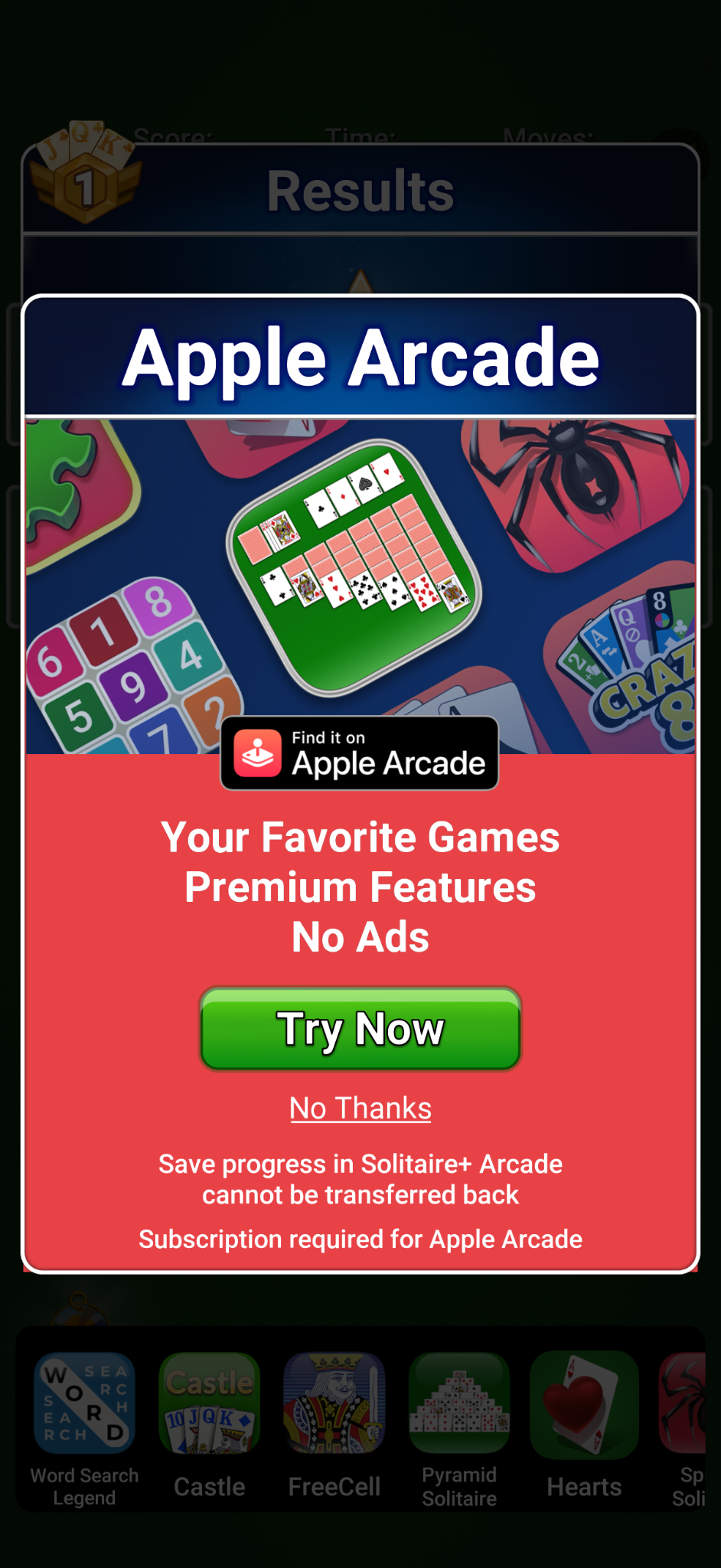
Enter the free-to-download Solitaire app developed by MobilityWare. While not explicitly stated on the MobilityWare website, their Solitaire app appears to have a bit of a following on forums and websites frequented by those with memory issues and their caretakers. Users cite that the game is easy to beat because the standard setting allows players to be dealt a single card at a time, as opposed to the three-card deal in traditional Solitaire rules. Others highlight the “extensive range of accessibility options.” Despite these accolades, I still find myself regularly annoyed by the nefarious and insidious advertisement practices employed by this app — especially one frequently used by those who suffer from memory problems.
The tiniest X you’ve ever seen
All of my issues with this game come from the advertisements played between rounds. Between one round and the next, I received an AI-generated TEMU advertisement for “butter squishies” (see below). Even with my frankly more dexterous fingers (at least compared to other MobilityWare users), trying to hit the “X” to close the ad instead took me straight to the TEMU website.


Beyond the obvious annoyance of being taken to a secondary site because the “X” button either does not work or is so small to basically be pointless, the annoyances don’t stop there. Upon being dragged to the TEMU site against my will, I am greeted by a spinning coupon wheel advertising various discount dollar values (see above). Once again, an unobservant — or perhaps memory-challenged — player may believe that this spinning wheel is another part of the MobilityWare gameplay and spend a few seconds spinning it, increasing both ad revenue for MobilityWare and the chances of a player then going on to spend money on the TEMU site. So, not only are you being inundated with ads while trying to play these games, and not only are you frequently unable to escape them, but the ads themselves seem specifically designed or “gamified” to keep you engaged — even with non-game content.
What game is this anyways?
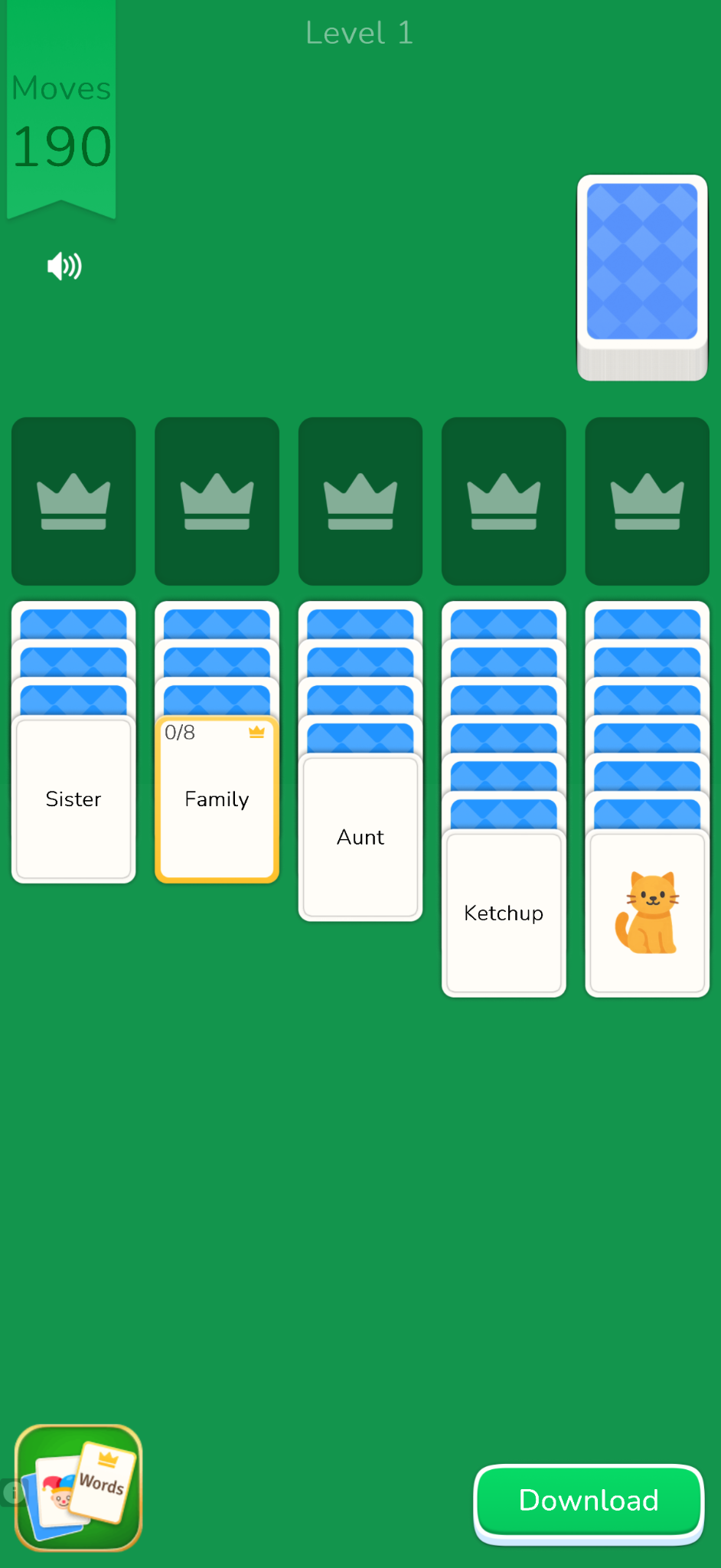
But of course, these goddamn ads don’t stop there. In addition to gamifying advertisements for things like TEMU, other ads targeting MobilityWare Solitaire players include ads for other free-to-download games that mirror MobilityWare game-play (see below). Once again, for users with dementia, Alzheimer's, other memory issues, or those who perhaps just don’t pay close attention, these ads look a lot like regular game-play, and may cause users to unknowingly engage with advertising content, thinking they are playing the MobilityWare game.
Attention, Extraction, Etc.
One might say, “Robin, what you’ve described here is a basic facet of advertisements overall. They are meant to capture your attention, to stick in your head. They are part of 21st-century life. You are not adding anything to discourse by pointing these facts out.” And while this is true, and while all of my complaints lodged here are absolutely trite, I will continue to assert, to scream, to beat a dead horse, that the actively adversarial nature of these user interfaces is just one facet of broader trends across society, but especially within tech. At every possible turn, it seems, there is a mechanism to extract more of a person’s time, money, and attention. If it’s not a free-to-download game trying to trick seniors into buying shit off TEMU, it’s the prediction market platform offering users the chance to make (and lose) money off of increasingly deadly natural disasters, its apps selling your location data despite existing policies forbidding the practice, or its recruiter websites selling your career information to data brokers as you try to find a job. Everywhere you look, our attention, our time, and our lives are being increasingly monetized.
To be clear, there is already a wealth of research, studies, and coverage of both the attention economy and the extractive nature of our current society. In 2021, the Edinburgh Futures Institute at the University of Edinburgh and the Digital Futures Institute at King’s College London launched the Centre for Attention Studies, whose website characterizes the current information environment we all live in as a “warzone.” While my complaints about these attention-sucking advertisements are certainly trivial (and mostly based on personal grievance), the Centre for Attention Studies asserts that the impacts of the current information and attention environment are leading to “the destruction of democracy.”
At the risk of sounding self-righteous, this is the exact reason I stopped using TikTok. As an avid user since the COVID-19 lockdown, and a researcher into online spaces and harms, it has become increasingly clear to me that our lives and broader society have been made worse by the current attention landscape, or really, our decreasing ability to pay attention to anything. And while once off TikTok I attempted to fill that dopamine void with free-to-download mobile games, it once again became clear that those also were attempting to steal my attention. So for now, I’m off the stuff. And with nothing but time and an actively repairing attention span, I’m now left with the scariest question that all of these attention-stealing platforms allow us to avoid — now what?
Thanks to Hampton as always for thoughtful edits. All mistakes, however, are my own.