AI-Generated Lost Futures, Trainwreck Viewing, and Hallucinating Engagement

Warning: big spoilers for Squid Game (all seasons) and also for AI slop content purporting to be continuations of the show (just in case you’re bizarre and care about that!). Continue only if you are okay with the above.
While searching for some clips of scenes from Squid Game for an article on my personal blog, I came across a whole slew of AI-generated episodes of the Korean Netflix show Squid Game on YouTube. I’m not going to lie, my first thought was that I had somehow missed the return of a show I thought had finished about a year ago.
Anyway, I sent a clip to Robin and said I was for sure going to be writing about it for WXQT. So here’s a quick blog post about AI-generated ‘sequel’ content unironically created as a ‘fan-made’ follow-up to the original show.
While on one hand these videos are an obvious ploy for cheap views using recognizable IP, they also point to a key way that nostalgia functions online. How many of us have started and followed a series, only to find it canceled, cut down in its prime? How many of us have watched a show’s finale and immediately checked if it had secretly been granted just one more season? Psychologist Adam Gerace has articulated some of how this works, parasocially, through a survey of nearly 1,300 fans shortly after the finale of the Australian series Neighbours, which found that stronger parasocial investment in characters strongly predicted grief and loss reactions when the series ended.
I think this same phenomenon is being demonstrated by this AI-generated Squid Game content.. Nostalgia generates demand for content that carries a lost world forward, in this case, additional chapters to a familiar television story. Digital media has allowed for the timeframe of this nostalgia to accelerate — viewers and fans demanding follow-on content as soon as a series ends. This is something that Mark Fisher spoke about (specifically regarding lost – and cancelled – futures) and that Grafton Tanner has written about (for example, retrobait). With AI slop channels seeking any opportunity to fill our social media feeds with cheap, quick, and low-entry content, this ‘continuation content’ is an easy get. Unfortunately, AI-generated content is so aesthetically hostile that it seems to produce more disgust than satisfaction, even for the most nostalgia-driven viewer. But whether humans find this content pleasant to consume may not matter — the current content consumption ecosystem online means it isn’t totally clear if the viewer of this content – target or realized – was ever (fully) human.
Squid Game, the Finale, and Immediate Retcon Material
Netflix aired the first season of Squid Game in September 2021 to immediate audience acclaim. The show, created by Hwang Dong-hyuk and starring Lee Jung-jae as Seong Gi-hun, takes place in a South Korean games competition in which 456 desperate people vie for a prize pool that grows as others are eliminated from the games (by death). It is a deeply anti-capitalist show that serves as an allegory for Korea’s own brand of hypercapitalism. This critique makes Squid Games a strange target for AI-generated nonsense for views online, but so, too, did the Call of Duty skins and Netflix reality TV spinoff.
The finale of Squid Game season three was met with admittedly mixed reviews online when it aired in summer 2025. As James Pero described in a Gizmodo article, Squid Game fans immediately turned to generative AI to create retcon endings that they (and many other fans) wanted. These retconned endings are mostly on microvideo platforms like Instagram Reels and TikTok, short in length, and specifically not serialized.
Two details about the finale of Squid Game season three are relevant to my point of inquiry here. First – and the plot point fans had the most anger towards – the main character Gi-hun sacrifices himself, jumping to his death with the final words, “We are not horses. We are humans. Humans are…”. Second, Front Man, played by Lee Byung-hun, visits Gi-hun’s daughter in Los Angeles to deliver prize money to her and then sees Cate Blanchett playing the role of a recruiter for the games, playing ddakji with a bedraggled American man in an alleyway.
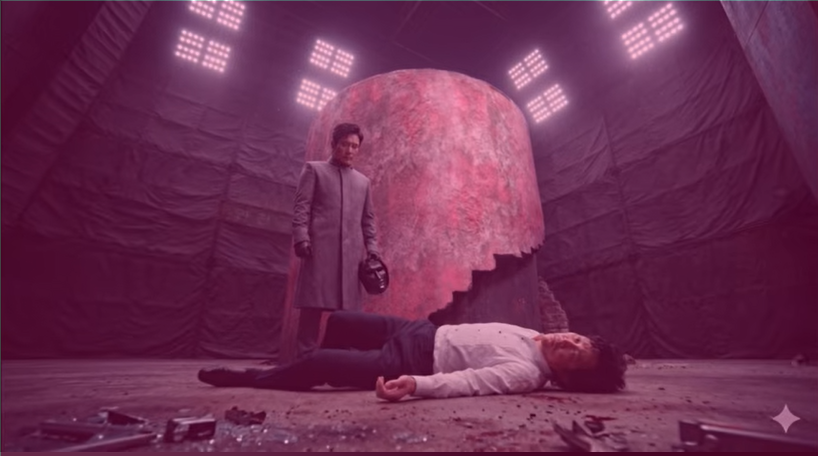
The first detail (Gi-hun’s sacrifice) serves as a moment of finality for the whole show, while the second (Blanchett’s presence) serves two contradictory angles. Her presence both closes the narrative loop of the series while widening the possibility that the games may soon be played in another country. The AI film slop channel that I sent Robin (and have watched in its entirety now) responds directly to both plot points: the first scene in the AI-generated “season 4 part 1” shows that Gi-hun had survived his fall, followed by a series of poorly-cut single-line deliveries by Blanchett, now the American games recruiter.
The AI Seasons: Nostalgia, Click-Seeking, and (Un)Helpful Advice
To save you from having to watch these AI-generated “sequel” videos, allow me to describe them. They’re quite short — usually a bit over a minute (on average a minute and a half) long, with the longest (part six of season four) being at 2:19 minutes and the shortest (season four, part eighteen, the finale) being only 46 seconds. Season five of these AI-generated sequels, currently “airing” at the time of writing (now at episode five), has a shorter average episode length than the previous season, suggesting that these accounts may be putting less and less time into this retconned content. That doesn’t appear to have impacted the number of views — the longest episode, part six of season four, is also the most viewed video on this channel, at almost 4k views, a surprisingly high count for a channel with just a little over 100 subscribers.
While the channel is mostly AI-generated Squid Game content, it has also posted AI-generated content from other franchises. This includes an AI-generated trailer for “Titanic 2” as well as trailers for other would-be sequels: “IT you’ll float too”, “nun returns”, and “THE DARK NIGHT AGAIN”. Notably, while the actual movie IT doesn’t have a sequel, both The Nun (2018) and The Dark Knight do have existing, non-AI-generated follow-ups: The Nun II (2023) and The Dark Knight Rises (2012). Trailers are often how creators generate desire for future projects, and it’s strange to see a parallel creation at play here: the channel creator is generating desire for something with a canonical continuation, but with completely different new plotlines and scenes. It is unclear whether these channels just don’t know about the existing sequels when prompting AI to create these retconned videos, but I imagine this is more about their desire to make and upload a cool video with the hope of getting some passive income down the line.
Comments on these videos are rare (and most are iterations of “:O” or “wow”), but on “squid game season 4 part 3” a random viewer commented the following:
Is this real? Nah they said WON insted of d
DOLLARS ₩ 💰 AND THAT CLIP WAS FROM S1 ALSO BTW GI HUN IS DEAD SO…
The creator of the video, who notably has marked all of these videos as AI-generated, replied directly, “No, it’s AI”. On another video, another user asks “How to make videos like these??” and the owner of this channel helpfully replied, “Using ai.” They’re not hiding anything, but they’re also certainly not giving away the keys to the AI castle.
Taking Psychic Damage
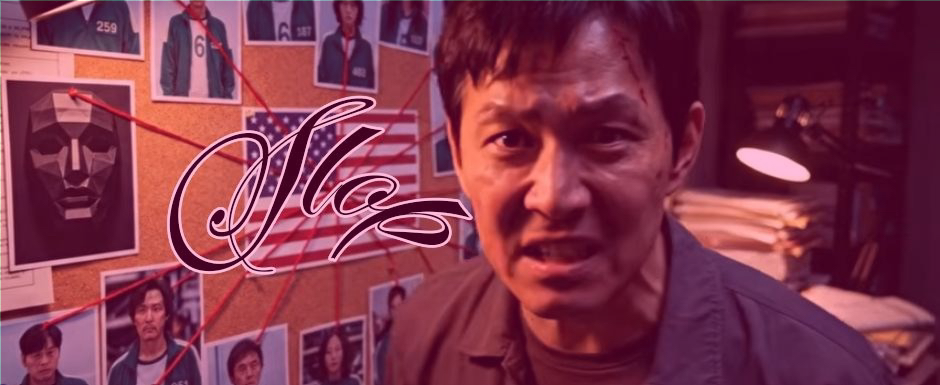
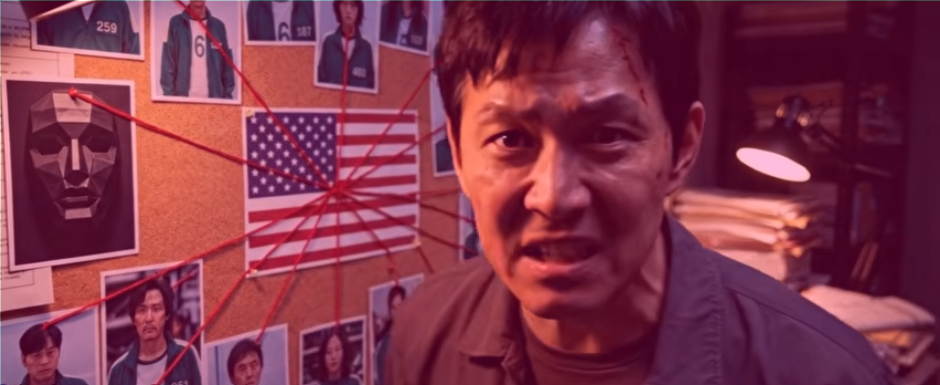
The video content is deeply inconsistent, has weird cuts, and – perhaps most importantly – misses the anti-capitalist point of the original Squid Game by a mile. In the first AI-generated episode, Officer Hwang Jun-ho and former mobster Choi Woo-seok have a neon-heavy street race in fancy cars. In the short season four finale, the Front Man (with glowing red eyes in this shot) gives the order to “Fire the Island” after a scene that seemingly conflates Gi-hun and the Front Man. I suppose this is the generative AI version of a cliff-hanger (indeed, a user commented pleadingly, “Season 5????”). AI-generated season five part two ends with a three-second scene, featuring Seong Gi-hun standing in front of a corkboard with red thread linking contestants and the Front Man’s mask to a printout of the American flag. He turns to the camera and asks, “AGAIN?!”
The reality is that I watched every damn AI-generated episode (begrudgingly? as one watches a train wreck? who’s to say?). While doing so, I told myself that this was because I wanted to write something about it for WXQT, but I think that’s too simple. There’s some sort of link between both my desire to see these characters and settings on the screen again and the disorienting experience of watching AI-generated slop content. On the latter, there is a really good essay on the currently-on-hiatus Blood Knife blog (truly an excellent publication) detailing how, in the early era of AI-generated nonsense, such content felt novel and interesting. I’d contend that we’ve definitely turned a page, where this initial contested novelty has turned to disgust. The atrocious viewing experience of these AI-generated Squid Game scenes only exacerbates this disgust: snap zooms, repeated movements with slightly different sentences, formulaic character moves we’ve all come to associate with AI-generated videos, etc. It doesn’t take a 22-year-old Letterboxd art-hoe dude to see the complete derision of the art form, as this content actively antagonizes you as you watch it.
Hallucinating Viewership, Moving Beyond Dead Internet Theory
The 18 episodes (“parts”) of the first season of this AI-generated Squid Game content are very short videos, making it easy to accrue views (and potentially garner revenue). The channel barely has a three-digit subscriber count, yet several videos have cracked into thousands of views. Perhaps a computer viewer (in the form of YouTube autoplay) algorithmically sifts through these fake episodes in chains of autoplay. When someone plays a part of a series on YouTube, autoplay is more likely to try to find the next video, thereby serving the viewer what Google’s algorithm thinks would be the next logical video segment. There are legitimate clips from the show stitched between AI clips, and the generative AI sometimes starts with what appears to be a frame from the show before uncannily diverging into overtly AI-generated content. This visual similarity may also contribute to these videos appearing in feeds, searches, and recommended videos.
Liam Curtis, writing for Kapwing, studied 15,000 trending channels on YouTube last year and identified nearly 300 channels that produced nothing but AI slop content, collectively garnering over 63 billion views and 221 million subscribers (accounting for about $117 million in annual ad revenue). In May 2026, YouTube began cracking down on AI slop, but this Squid Game slop channel appears to have evaded content moderation efforts. This channel is also much smaller in scale than the almost 300 channels that Kapwing studied, so a lot of what I’m writing about here is admittedly anecdotal.
The audience for this computer-generated content, therefore, may very well be other automated systems, in the form of an auto-play feature with or without a human present to hear or watch. If a video plays on the second monitor and the user isn’t around to hear it, YouTube still tallies the play (and potentially serves an ad spot beforehand).
I think this is a little bit of a different conundrum than the so-called Dead Internet Theory, which posits that the Internet is mostly bots talking back and forth. In some ways, what I’m pondering over this Squid Game content is less about the communicative process of content online, but about the consumptive one. I suspect that viewing this as a wholly automated phenomenon is also incorrect, as autoplay functionality on YouTube is not a completely passive process – the human pilot/operator can always click out of an autoplay loop. Again, I am not YouTube and cannot determine how much of this type of video is being consumed by humans versus bots, but the overall experience of consuming and encountering this content via the autoplay feature feels deeply inhuman
Through my experience as perhaps a minority of human viewers of this content, I was pulled through all of these episodes despite my negative affect towards the content. I mentioned the train wreck metaphor earlier, and I do think that the sheer disgust I felt in watching this slop meant to show a continuation of a show that I thought had a stellar ending outweighed my better judgment. In a sea of likely automated viewers, I find myself perhaps as a rare human, yet feel no impulse to join those commenting queries as to how to replicate this shitty content.